Before starting out on this ridiculous Whole30 journey, our dinner routine was the same old thing week after week: Food shopping on Sunday night with the best of intentions. Chicken and veggies on Monday night. Turkey Taco Tuesdays. Wednesday would be more chicken and veggies. By the time Thursday came around, we’d be sick of cooking, so we’d get a little cheapie take-out. Friday Funday calls for dinner out and drinks. Then Saturday breakfast on the go, followed by a weekend of “Where should we go for lunch?” and “Where do you want to eat dinner?”
It was a vicious cycle.
One upside of Whole30 has been that we’re forced to try some new recipes and think outside the chicken-and-veggies box. If you’ve been following along, you’ve seen some of our new fav’s. The turkey meatballs and loaded sweet potatoes are right up there. I haven’t even told y’all about The Husband’s chili he made last week.
Trying new recipes each night can be a little exhausting though. This is when it pays to have a staple, like my basic chicken and veggies.
You know that one go-to dish you have in your repetiore that you can make in your sleep? This is one of mine. (The other, in case you were wondering, is my mom’s chocolate chip cookies. But I’m not going to think about those sweet, crispy-on-the-outside, warm-and-gooey-on-the-inside, melt-in-your-mouth, better-than-anything-on-the-planet cookies.)
Chicken and veggies is cheap, quick and easy. Just like me.
This meal is perfect if you’re pressed for time. The total cost is going to range depending on the quality of meat you buy and whether you’re buying frozen or fresh veggies, and whether they’re in season. You can go dirt cheap and get a pound of chicken tenders for about $4 and a bag of frozen veggies for another $2. On the higher end, you can buy the larger vegetarian-fed, no antibiotics, raised without hormones, fancy pants chicken breasts that Whole30 encourages, and that will run you about $10 or more for a pound and a half.
If you already know how to make basic chicken and veggies, there is no need to read any further. Unless you like a good joke about large breasts. That’s going to happen. But, if you don’t know shit about dick when it comes to cooking, I invite you to read on.
Disclaimer: This is not a recipe. This is my own personal method. And I’m not professional trained to work in a kitchen. (Obviously.)
To make chicken and veggies, you only need about 30 minutes max. Turn on your oven to about 400° and get out one large nonstick pan and one oven-safe pan. You’re also going to want a good pair of tongs.
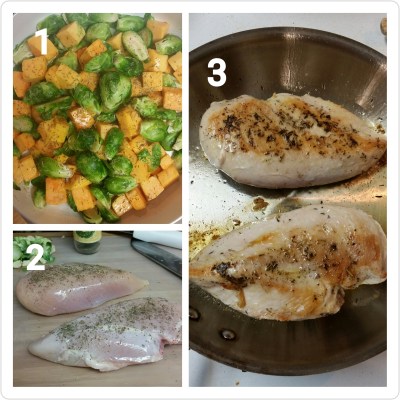
Start with prepping your veggies. This process is going to depend on what you’re working with, obviously. For this example, I’m using Brussels sprouts. You want to buy the tiny ones; they’re more tender. The large bulbous ones are a little rough to eat. I like to cut off the stem part as much as possible and then halve them. Get some kind of fat (either olive or coconut oil works best here) going in your nonstick pan and swirl that puppy around. Once it’s hot, place the sprout halves flat-side down in the pan. All of them. When there’s no more room left, just throw them all on top. Everybody in the pool.
A package of pre-cut butternut squash is a great compliment to Brussels sprouts and adds another level to a basic chicken and veggies dinner. They will get squishy fast, so don’t be in a rush to add these. In fact, if you want to redirect your attention to the chicken and then come back, that will work just fine.
You’re probably wondering about seasoning at this point. This is my only “trick” when it comes to chicken and veggies. I don’t even know that it’s a trick. More like a guideline.
I used to date this guy whose mom told him he should never date a girl who didn’t wear panties that matched her bra. (We broke up.) Apply this rule to your chicken and veggies: Whatever seasoning you put on the bird, you put on the veggies.
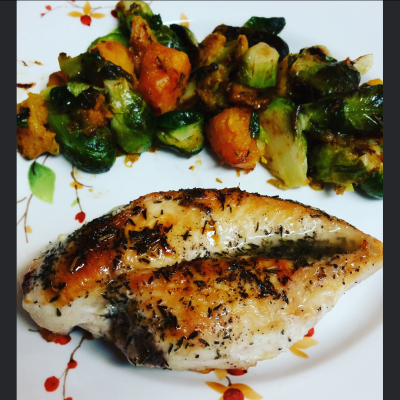
This helps change your dish up. If you’re using peppers and onions, go for some chili powder, paprika and fresh garlic. If you’re using asparagus, lemon pepper and fresh lemon juice is perfect. For Brussels sprouts and butternut squash, I like something a little more savory, like dried rosemary and thyme. No matter your combo, you’re always going to start with kosher salt and black pepper. If you don’t have a pepper grinder, no bigs. If you do, mazel tov.
So you’ve got your veggies in the pan and your chicken out on the board. Salt, all the way around. Pepper. Sprinkle that thyme all over. Take about a tablespoon of rosemary in the palm of your hand and use your fingers to grind them down, then you can throw that on top. I’ve learned to use rosemary conservatively. It’s lovely, but very powerful. Just like me.
Your seasoning is done, time to get that bird on the stove. Put your choice of fat or oil (remember, matchy matchy) in the oven-safe pan. When it’s hot, GENTLY lay down each breast so you don’t get oil splatter. This here is very important: Once you’ve put the chicken in the pan, DON’T TOUCH IT.
DON’T poke at it.
DON’T push it around.
DON’T try to lift it up.
What you’re trying to do is brown one side real good, then you’ll flip it and brown the other side real good. How do you know when it’s time to flip it? When you can use your tongs to pick up the breast and it lifts up without sticking. But you just told me not to try to lift it up…? I know. Life’s a bitch, isn’t it?
Keep an eye on how long one side takes before you can flip it. However much time it took to cook the first side is a good measure for how long you should leave it on the other side, but I generally give it a minute or two less. You’re going to take the pan at this point and put it in the oven, so it will continue to brown on that side while it’s cooking.
The amount of time these stay in the oven depends on how large your breasts are (HEEYY-O!). If you’re using tenders, you are going to skip putting it in the oven entirely because they’re so small and pathetic they’ll cook on the stovetop and finish in no time. If you have large breasts, like me (winky winky), you’ll want to cook them between 20 and 25 minutes, including the time they spent stovetop.
The tricky part is that chicken is one of those things you definitely don’t want to undercook, but you also reallllly don’t want to overcook. Dried chicken is awful. But so is food poisoning. This is why God invented meat thermometers. Use this to tell when your chicken is done. This being said, I will tell you that every time I’ve cooked chicken until it was ready by my meat thermometer’s standards, it came out drier than a Christmas tree in March.
Bobby Flay, if you’re reading this, I love you but please don’t read what I’m about to say. To make sure the chicken is done, I will usually take a knife and cut into one of the thickest parts of the breasts. If it’s pink, it’s not ready yet. No pink? Time to eat. You will lose some of the juice by doing this, but it’s better to be safe than vomiting.
So there you go. Chicken and veggies. It’s so easy, even I can do it.
Note: This is a re-post from the Tumblr version of this blog. It originally ran on April 12, 2016.




 The Ding is My Thing.